


What You Missed at AAF Inland Empire's April 30th Brand Webinar — And Why It's Worth Knowing About

Let's be honest about something.
On April 30th, AAF Inland Empire hosted a webinar that — if you were there — you already know delivered more than most sessions do in twice the time. And if you weren't able to make it? This recap is for you.
Andrew Wilkin, Certified Brand Strategist, National ADDY Award winner, and Inland Empire agency veteran, spent 90 minutes walking our chapter through his Complete Brand Framework — a working, battle-tested methodology for building a brand from the inside out. Not theory. Not buzzwords. A usable framework that applies whether you're advising a local startup or a mid-sized manufacturer pushing into new markets.
We promoted it, we opened the doors, and the session delivered. Here's what was on the table.

First, He Reframed the Whole Game
Andrew opened with a question that sounds simple until you actually try to answer it: What is a brand?
The old answer — a singular claim of distinction — is dead. That's a positioning statement, not a brand. Today, a brand is the meaning people attach to you and your offering. Not what you say it is. What they say it is.
That reframe matters enormously for everyone in this industry, because it changes where the real work happens. It's not in the logo. It's not in the color palette. It's not in the tagline. Andrew was unambiguous about this, and it was a useful gut-check for a room full of people who spend a lot of time on exactly those things.


Brand Development vs. Branding: A Distinction That Costs Companies Real Money
One of the sharpest distinctions Andrew made was between brand development (strategic) and branding (tactical). These are not synonyms, and treating them as such is one of the most expensive mistakes a business can make.
Brand development is the discovery of your brand's distinction — the upstream work that defines what you mean to your audience and why that matters. Branding is the consistent, repeatable execution of all those elements — the logo, the graphics, the imagery — that creates a recognizable customer experience over time.
Neither is more important than the other. But if you skip the strategic development and jump straight to the tactical execution, you're building a beautiful house on an empty lot. It looks great on the drive-by. It falls apart under pressure.

Why Bother? Because the Numbers Are Uncomfortable
Andrew didn't ask the room to take his word for it. He came with research.
Companies with strong brand strategy see 46% greater market share gains (Havas), 10x better performance (EY/HBR), 70% better sales throughput (Kantar), and 3x faster growth (Deloitte). On the talent side: 83% more meaningful work for employees, 80% higher engagement, 21% greater profitability, and 5.3x better staff retention (Harvard Business Review/Ernst & Young).
That's not a branding argument. That's a business argument. And Andrew made it clearly: brand development is not a cost. It is a catalyst for growth, investor confidence, faster sales cycles, and shareholder value.
If you've been trying to convince a client — or a CFO — that brand strategy is worth the investment, this session handed you a loaded slide deck.


The Complete Brand Framework: All of It, in One View
Andrew then walked the room through his full architecture. This is the part that's genuinely hard to convey in a recap, because it's comprehensive — 13 distinct components spanning brand strategy and brand expression.
The framework runs from Brand Substance (purpose, vision, mission, values) through Positioning Strategy (audience, competitors, difference) into Brand Persona (personality and voice), Communication (core message framework, storytelling, naming, tagline, hooks), and finally Visual Expression (identity system and brand presence).
What separates this from a generic branding checklist is that every element is connected. Andrew's point — made repeatedly — is that nothing downstream holds up if the upstream work is soft. If your positioning is unclear, your messaging drifts. If your values are just wall art, your culture suffers. If your persona isn't distinct from your top three competitors, you're already in trouble.
He called it "planting the flag." Everything traces back to it.

He Named the Trap Most Brands Fall Into — and It Was Uncomfortable to Sit With
Andrew introduced a concept from UK brand strategist Matt Davies, whom he calls "The Brand Trap": the dangerous tendency to imitate whatever's working for the market leader, on the assumption that it'll work for you too.
The result? A homogeneous marketplace. Foggy positioning. Products with no meaningful differentiation. Price wars. Disengaged customers — and staff who don't care either.
His case study was the bottled water industry. There are 479 water production businesses in the U.S. alone, and over 2,800 companies involved in distribution and manufacturing. It is, by every measure, a sea of sameness.
And then came Liquid Death. Mountain water in a tallboy can. An anti-plastic environmental mission. A brand voice that borrows more from heavy metal than hydration marketing. Revenue went from $2.8 million in 2019 to $333 million in 2024 — over 100x growth. A $1.4 billion valuation. Expansion into 133,000 retail locations. Dominant penetration among Gen Z and Millennials.
The product is water. The brand is the entire reason it exists at the scale it does.
Andrew's message was simple: radical differentiation isn't risky. Sameness is risky.


Brand Archetypes, Storytelling, and the Human Face of a Brand
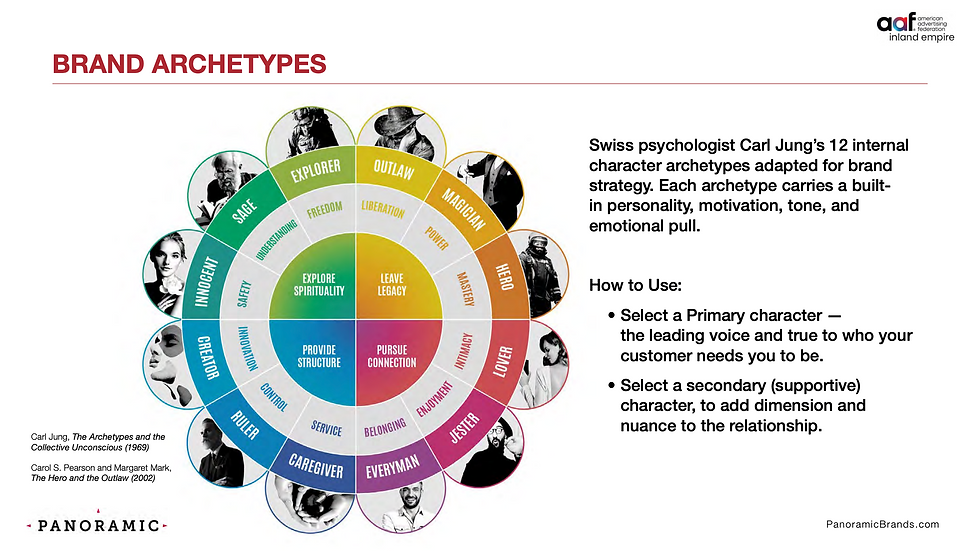
The session then moved into territory that's particularly relevant for the creatives and strategists in our chapter. Andrew introduced brand archetypes — rooted in Carl Jung's psychology and adapted for brand development by Pearson and Mark — as a tool for defining the personality and character of a brand.
He walked through four quadrants: Legacy Builders, Connection, Structure, and Exploration/Spirituality — with archetypes like The Outlaw (Virgin, Harley-Davidson, Diesel), The Magician (Coca-Cola, Disney, Dyson), and The Hero (Adidas, Nike, FedEx) mapped against brand voice, message, color, and strategy.
The point wasn't just typology. It was specificity. A brand persona that's genuinely distinct from your top competitors, that leadership can actually live up to, that scales across social, sales, content, and customer service — that's the goal. And it has to feel authentic, not like a costume.
Andrew also covered messaging frameworks — the house model, Salesforce as a case study — and storytelling frameworks including the StoryBrand approach (customer as hero, brand as guide), the Pixar story framework, and the Hero's Journey. These are tools our chapter members can use immediately with clients.
The Q&A Was as Good as the Presentation
For those who missed it: the Q&A didn't feel like an afterthought. The room went deep.
There was a pointed discussion about the brand promise — where does it live inside this framework? Andrew's honest answer was that the unique value proposition and positioning statement are where that work happens, even if the phrase "brand promise" doesn't appear on the slide. He acknowledged it, engaged with it, and explained how those elements narrow everything down to the North Star.
There was a sharp exchange about cause marketing — and whether brands that take public political or social positions are making a strategic mistake. Andrew was measured but clear: it can work for some brands (Patagonia has stayed true to its values and benefited for it), but it can also backfire spectacularly (Bud Light, Pepsi). His point: if a position isn't deeply rooted in who you actually are as a company, it reads as opportunism — and audiences remember.
There was also a conversation about personal branding alongside company brand-building. How do you allocate finite time and budget between building your own profile and building the company's? Andrew's perspective: some brand strategists start with the founder's personal brand first — because the CEO is the brand, especially in the early stages. Get that right, and the company brand follows more naturally.
These weren't easy questions. Andrew handled them like someone who's been on both sides of the table for 30 years. Because he has.
Here's What Made This One Worth Showing Up For
Everything covered in this recap — and this doesn't come close to covering everything — was available to AAF members at no cost. Ninety minutes. A lunch break. A Wi-Fi connection.
Andrew made himself available, offered to send the full PDF of the presentation to anyone who reached out, and engaged thoughtfully with every question the room threw at him. That kind of access to working expertise doesn't come around every session.
If life got in the way this time, that happens. But sessions like this one are exactly what your membership is designed to deliver — and we'd hate for you to keep missing them.
Andrew can be reached at andrew@panoramicbrands.com and on LinkedIn at linkedin.com/in/andrewwilkinsstrategist. The presentation PDF is available directly from him.
Don't Miss the Next One
AAF Inland Empire exists to connect marketing and advertising professionals across the region through education, community, and — yes — a healthy competitive spirit. Events like this one are the educational part. They're what your membership is for.
Stay connected. Watch this space. When the next session drops, register before you talk yourself out of it.
You can always catch up on a recap. You can't catch up on being in the room.


Comments